Georgia Sales and Use Tax for Contractors, in Plain English
You bid the job. You bought the materials. You never charged your customer a penny of sales tax.
So why does the Georgia Department of Revenue think you owe it?
Because in Georgia, a contractor who improves real property owes the tax on the materials. The tax is yours, even when the homeowner or developer pays the bill.
Most contractors I talk to have heard some version of that rule. Very few have seen how it plays out across the jobs they actually run: the repair call, the shop-fabricated rail, the pallet of fixtures ordered from a supplier in Tennessee, the school job where everyone assumed the materials were exempt.
This guide walks through all of it in plain English. It's written for Georgia contractors and construction company owners, and it's part of how I approach tax planning for contractors in Georgia: income tax, sales and use tax, and cash flow, looked at together.
Let me be blunt about one thing up front. Sales and use tax rarely shows up as a big number on any single invoice. It shows up three years later, in an audit, across every job you ran.
The core rule: you are the consumer
Here's the rule in Georgia law, translated.
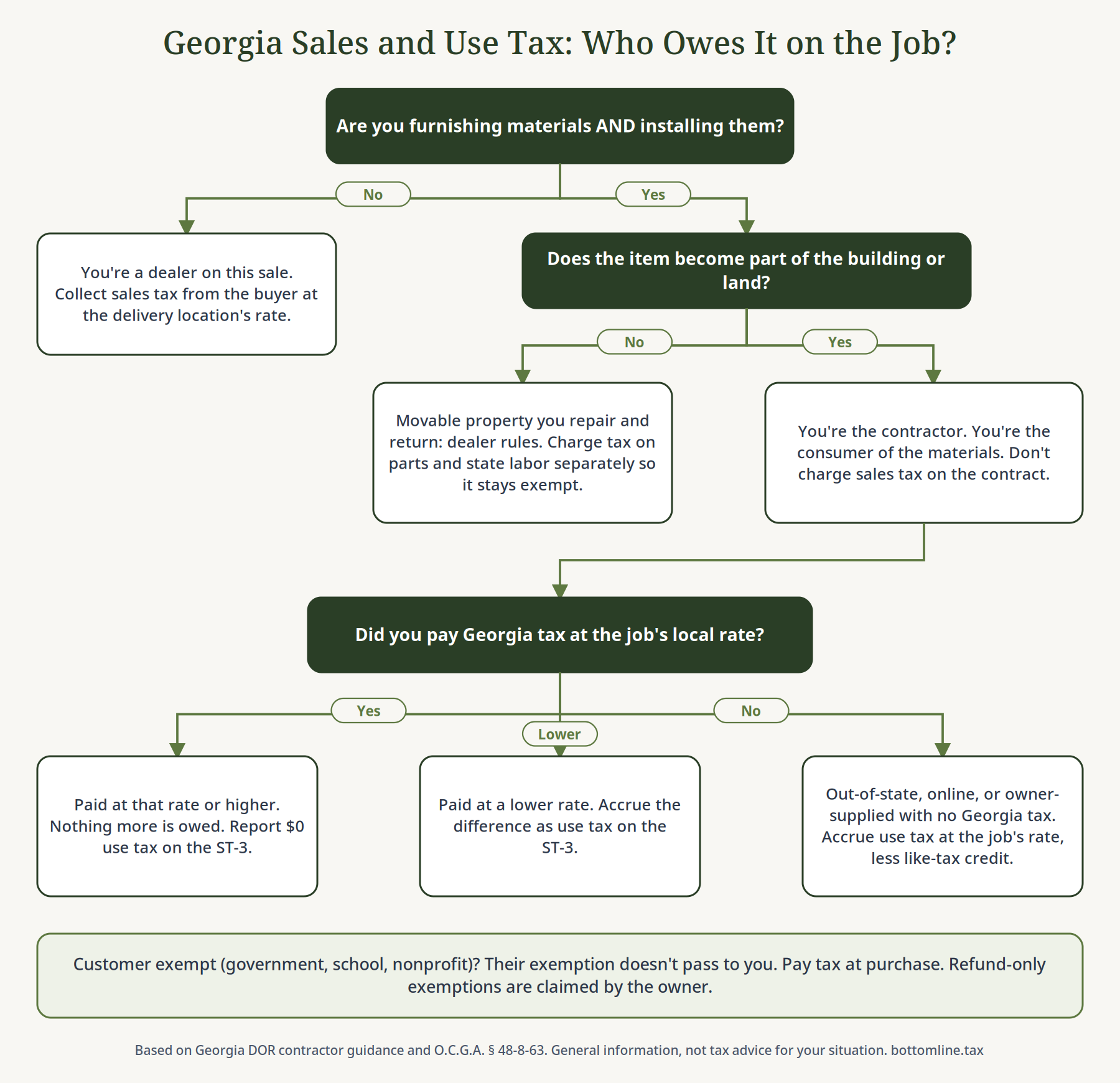
If you contract to furnish materials and perform services to construct, alter, repair, or improve real property in Georgia, the state treats you as the consumer of those materials. You pay the tax when you buy them, use them, store them, or consume them in Georgia, whichever comes first (O.C.G.A. § 48-8-63; Rule 560-12-2-.26).
Three things follow from that.
You can't buy construction materials tax-free. The Georgia DOR says it plainly: contractors are consumers and "must pay tax at the time of purchase." That holds even when the job is for a government agency (Georgia DOR Contractor FAQs).
You don't charge sales tax on the construction contract. Your tax is on what you bought. Building the cost of that tax into your price is normal. Adding a "sales tax" line to a construction invoice confuses the customer and does nothing to cover the tax you owe on your materials.
You still have a sales and use tax account. Every contractor, resident or nonresident, general or sub, has to register for a sales and use tax number (STN) through the Georgia Tax Center (Georgia DOR Tax Guide for Contractors). That surprises a lot of owners who assume sales tax accounts are only for stores.
In Georgia, the contractor owns the tax on the materials. Price it, pay it, and document it.
Real property improvement or a sale of goods?
The core rule only applies when you're improving real property. When you sell goods, a different set of rules applies, and you're treated as a dealer.
The question to ask is simple. When the job is done, is the item part of the building or the land?
A water heater plumbed in, ductwork, a roof, a poured slab, built-in cabinets, wiring in the walls. That's a real property improvement. You're the contractor, and you pay tax on the materials.
A unit sold off your shelf and handed to the customer, or equipment delivered with no installation. That's a sale of goods. You're the dealer, and you collect sales tax from the customer.
Georgia's own HVAC guidance shows the split. A business that sells HVAC equipment without installing it is a dealer and collects tax from the buyer. The same business that supplies and installs equipment into real estate is a contractor and pays tax on the equipment and supplies it uses (Georgia DOR Informational Bulletin 2007-2-13, summarized by Litwin Law).
Plenty of trades do both. An HVAC company, an electrician with a counter, a cabinet shop that installs some orders and ships others. Each line of business follows its own rules, and your books need to show which is which.
Four scenarios, worked through
The examples below use the rate scenarios the DOR uses in its own contractor examples (Georgia DOR Sales and Use Tax for Contractors Examples). Georgia's state rate is 4%, and counties and cities add local taxes on top of it, so the total rate depends on where the materials are used (Georgia DOR Tax Rates). Check the current DOR rate chart for the county where each job sits.
Scenario 1: New construction
You're building a new home. You buy lumber, fasteners, windows, and drywall from a Georgia supplier in a 6% jurisdiction, and the supplier charges 6% sales tax. The house is in the same 6% jurisdiction.
What you owe beyond the invoice: nothing. The tax you paid at the counter covers it.
What you report: zero use tax on that month's ST-3.
What you charge the homeowner: your contract price. No sales tax line.
Now move the job. Same purchase, same 6% paid, but the house is in an 8% jurisdiction. You owe the 2% difference as use tax, reported on your ST-3.
And if you bought in an 8% jurisdiction and built in a 6% one? You report zero. Georgia doesn't refund the extra 2% (Georgia DOR Examples).
Think about it. If your supplier delivers from a lower-rate county to jobs in a higher-rate county all year, you owe the difference on every one of those jobs.
Scenario 2: Repair work
A storm takes out part of a commercial roof. You tear off the damaged section and replace it.
That repair is still work on real property. The core rule applies the same way it does on new construction. You pay tax on the shingles, underlayment, and flashing, and you don't charge sales tax on the repair contract.
The rules change when you repair movable property and hand it back: a piece of equipment, a unit pulled out and bench-repaired, a customer's machine. That's dealer territory. Repair and installation labor is exempt only when it's separately stated on the invoice. If it isn't, the whole charge is taxable (Georgia DOR Contractor FAQs; Rule 560-12-2-.88).
A one-line invoice that says "Repair, $1,800" can make the whole $1,800 taxable.
Scenario 3: Fabricated materials
Your shop cuts, bends, and welds steel into custom stair rails, then your crew installs them on a job.
Georgia treats fabrication as producing an article by giving materials a new form, including cutting, shaping, and bending. When you sell fabricated items, the fabrication labor is part of the taxable price, even if you list it separately (Rule 560-12-2-.88; Georgia DOR Contractor FAQs).
For a contractor fabricating only for its own installs, the usual treatment is to pay tax on the raw steel when you buy it. You're the consumer of that steel, so the shop work doesn't change who owes the tax.
The risk shows up when a shop does both: it sells some fabricated pieces to other contractors and installs others itself. Georgia has a separate rule for these "dual operators." It allows tax-free buying for resale, then requires use tax on the fabricated cost of anything pulled into your own contracts. That's a bigger number than the raw steel. That rule overlaps with a later inventory rule that taxes purchased stock at cost price (Rule 560-12-1-.17; Rule 560-12-1-.14).
If your shop sells and installs, get the treatment confirmed before an auditor confirms it for you.
Scenario 4: Out-of-state and online purchases
You order a pallet of light fixtures from a supplier in Tennessee. They charge 6% Tennessee state tax and 1% local tax. The fixtures go into a job in a Georgia jurisdiction with a 6% total rate (4% state, 2% local).
Georgia gives credit for tax legally paid to another state, but only like tax against like tax: state against state, local against local (Georgia DOR Examples; O.C.G.A. § 48-8-30).
The 6% Tennessee state tax more than covers Georgia's 4% state tax. You owe no Georgia state use tax.
The 1% Tennessee local tax covers only half of the 2% Georgia local tax. You owe 1% local use tax.
You report that 1% on your ST-3.
If the out-of-state seller charged no tax at all, you owe the full Georgia rate for the job's location as use tax. The DOR's FAQ is direct about it: use tax is due when job materials come from an out-of-state vendor (Georgia DOR Contractor FAQs).
This is where online ordering catches people. The invoice looks clean and the price looks good. Nobody flags the tax that's still owed.
Use tax on materials you didn't buy in Georgia (or didn't buy at all)
Use tax is the other half of sales tax. It applies to the first use, storage, or consumption in Georgia of property bought at retail with no Georgia tax paid (Georgia DOR, What Is Subject to Sales and Use Tax).
For contractors, it comes up in three common ways.
Out-of-state and online suppliers that don't charge Georgia tax.
Rate gaps between the county where you bought and the county where you built.
Owner-supplied materials. If the owner or developer buys materials and hands them to you, and no sales tax was paid, you accrue use tax on those materials when they become part of the real property (Georgia DOR Contractor FAQs).
Read that third one again. Your contract might say "labor only." The tax on the owner's untaxed materials can still land on you.
One practical habit helps: have out-of-state suppliers ship straight to the job site, so the materials are first used in the county where they're installed and you aren't sorting out tax for two locations (Litwin Law).
When exemption certificates apply and when they don't
This is where most of the expensive confusion lives.
A customer's exemption is the customer's. A government agency, a church, a hospital authority, or a school may be exempt when it buys property directly. That exemption doesn't pass to you when you buy materials for their project. A Georgia appeals court held that a company buying materials as a hospital authority's purchasing agent owed the tax, because the authority's exemption didn't extend to it (Resourcing Services Atlanta v. Georgia Department of Revenue, 288 Ga. App. 532, 2007; cited by Georgia DOR Letter Ruling SUT-2014-15).
Your resale certificate covers resale. If you're also a dealer, you can buy inventory for resale tax-free. Once you pull that inventory into a construction contract, you owe use tax on it.
Some project exemptions exist, but most are refund-only. Georgia has a handful of construction-related exemptions where the contractor pays the tax up front and the owner claims the refund. A current example: for qualifying school construction projects funded by an education sales tax, local sales tax on construction materials is exempt from April 1, 2025, through December 31, 2033. State tax still applies. The DOR is explicit that contractors pay state and local tax at purchase and can't claim the exemption. Only the local school system can file for the refund (Georgia DOR Policy Bulletin SUT-2025-01).
Other refund-only exemptions work the same way, with the owner claiming the refund. Each has its own window and cap (Georgia DOR list of sales and use tax exemptions, O.C.G.A. § 48-8-3).
The planning point: if a bid package says the project is "tax exempt," ask in writing who claims what. Then price the job assuming you pay the tax at purchase, because in most cases you will.
Government and nonprofit projects
The same rules hold on public and nonprofit work.
You pay tax on materials for government contracts. The DOR says contractors pay at purchase "even if the materials are used in contracts performed for government agencies" (Georgia DOR Contractor FAQs).
Government-furnished materials need attention. When a Georgia governmental entity furnishes materials for you to install under its contract, state law requires it to give you advance written notice of the tax owed on that property (O.C.G.A. § 48-8-63(h); Georgia DOR Letter Ruling SUT-2014-02). If the agency skips that notice, the agency owes the tax. Get that notice, and keep it in the job file.
Nonprofits get no general pass. A nonprofit owner's tax status doesn't make your materials exempt. If a specific statutory exemption applies, the owner usually claims it by refund.
ST-C forms and filing mechanics
The paperwork is where good companies get caught on technicalities. Here is the short version.
Every contractor
Register for an STN through the Georgia Tax Center before your first job (Georgia DOR Tax Guide for Contractors).
File Form ST-3 every month, even when you owe nothing. The DOR says a return is due "for each filing period even if no tax is due" (Georgia DOR Examples).
File and pay within 20 days after the end of the month (Rule 560-12-2-.26).
General contractors
Notify the DOR on Form ST-C 214-5 within 30 days of signing contracts totaling $10,000 or more with a nonresident contractor, or $250,000 or more with a resident contractor (Georgia DOR General Contractor Withholding Requirements).
Withhold 2% of payments to a nonresident subcontractor with contracts of $250,000 or more, unless the DOR has confirmed that sub's sales and use tax bond. A Georgia sub can give you Form ST-C 214-6 to certify residency (Georgia DOR ST-C Contractor Forms).
Nonresident contractors (no established Georgia business location for at least one year before bidding)
Post a performance bond of 10% of any contract over $10,000. File ST-C 214-1 and ST-C 214-4, the right consent-to-service form (ST-C 214-8 through 214-11), and the bonding company's power of attorney, and pay a $10 fee (Georgia DOR Tax Guide for Contractors).
On contracts of $250,000 or more, a sales and use tax bond (ST-C 214-2 and 214-3) keeps the GC from withholding 2%. When the job is done, request the release of withheld funds on ST-C 214-13 within 60 days of completion (Georgia DOR Contractor FAQs; General Contractor Withholding Requirements).
Skipping registration or the bond has real teeth. Georgia can deny you the right to perform the contract until you comply (Georgia DOR Contractor FAQs).
The five mistakes that produce assessments
In my practice, these are the patterns that turn a routine sales tax account into a bill.
Not filing zero returns. The clock matters here. Georgia generally has three years from the date a return is filed to assess tax. If no return is filed, the tax can be assessed at any time (O.C.G.A. § 48-2-49). A zero ST-3 every month is how the three-year clock starts running.
Ignoring use tax on online and out-of-state orders. The supplier didn't charge Georgia tax, so nobody accrued it. Multiply that by every order for three years.
Missing the rate gap. Materials bought in a lower-rate county and installed in a higher-rate one, with the difference never reported.
Borrowing the customer's exemption. Buying tax-free on a school, church, or government job because the customer is exempt. The exemption belonged to the customer.
Mixing contractor and dealer work in the same books. Selling some items, installing others, pulling resale inventory into jobs, and invoicing repairs on one line with no labor broken out.
The cost stacks up quickly. Georgia's penalty for filing late is the greater of 5% of the tax or $5 for each month, up to 25%. Paying late carries the same penalty on its own. A fraudulent return carries a 50% penalty. Interest runs at the prime rate plus 3% (Georgia DOR Penalty and Interest Rates).
Documentation to keep
The whole game is documentation. Keep these for every job.
Supplier invoices showing the tax charged, the ship-to address, and the job they belong to.
A monthly use tax worksheet: untaxed purchases, rate gaps, and owner-supplied materials, by job and county.
Each ST-3 as filed, including the zero months.
Contracts that show what you agreed to do (install into the property, or sell and deliver).
Invoices that separately state labor on any repair or installation of movable property.
For GCs: ST-C 214-5 notices, subcontractor residency certificates (ST-C 214-6), bond confirmations, and withholding records.
For nonresident work: the DOR acknowledgment of your nonresident contractor status, kept with the job.
Any written notice of tax owed on government-furnished materials, and any written word from an owner about a claimed project exemption.
If an auditor asks about a job from 2024, can you pull that file in ten minutes?
How sales and use tax connects to your income tax planning
This is where sales tax becomes part of your tax planning.
Sales and use tax is part of what your materials cost. For federal income tax, sales tax paid on property you acquire is treated as part of that property's cost (26 U.S.C. § 164(a)). On a job, it belongs in your materials cost. On equipment, it's part of what you depreciate, which matters when you plan Section 179 or bonus depreciation.
That means your job costs are only as accurate as your tax tracking. If use tax is owed but never accrued, your gross margin on paper is higher than it really is. Then an assessment shows up years later, with no job left to charge it to.
It belongs in your bids. If you don't price sales and use tax into every bid at the job's local rate, it comes out of your profit.
It belongs in your cash reserve. Use tax is due every month. A contractor who sets aside money for income tax but not for use tax will feel it the month a big out-of-state order lands.
Revenue looks good. Cash feels tight. Hidden tax costs are one of the reasons.
If profit on paper keeps outrunning the money in your account, I wrote a separate piece on why that happens and what the cash side of the fix looks like: Profitable but short on cash.
One of my clients, a specialty contractor in West Georgia, put it this way:
"I was not worried about my taxes. That was the problem. I did not know enough to be worried. Now I know exactly what my structure is doing and why."
That's the goal here. Sales tax, income tax, entity structure, and cash flow, all working from the same numbers, on purpose.
Frequently asked questions
Do contractors charge sales tax in Georgia? On contracts to build, repair, or improve real property, no. The contractor is the consumer of the materials and pays tax when it buys or uses them. Contractors who also sell goods without installing them act as dealers on those sales and collect tax from the buyer.
Can a Georgia contractor buy materials tax-exempt? No. The DOR says contractors pay tax at the time of purchase, including on materials used in government contracts. A customer's exemption certificate doesn't transfer to the contractor.
Do I owe use tax on materials bought outside Georgia? Yes, when Georgia tax wasn't paid. Georgia gives credit for tax legally paid to another state, state tax against state tax and local tax against local tax. You report any remaining difference on your ST-3.
What if I buy materials in one Georgia county and use them in another? If the job's county has a higher rate, you owe the difference as use tax. If it has a lower rate, you owe nothing more, and Georgia doesn't refund the difference.
Do I have to file a sales tax return if I owe nothing? Yes. Contractors file an ST-3 every month, even when no tax is due. Filing also starts the three-year assessment clock.
Is labor taxable in Georgia? Repair and installation labor is exempt when it's separately stated on the invoice. If it isn't, the full charge is taxable. Fabrication labor is taxable.
What do nonresident contractors need before starting a Georgia job? Registration, plus a performance bond of 10% of any contract over $10,000, the ST-C 214 application, a consent-to-service form, and a $10 fee. On contracts of $250,000 or more, a sales and use tax bond prevents the 2% withholding.
Are school construction materials exempt from sales tax? For qualifying school projects, local sales tax is exempt from April 1, 2025, through December 31, 2033, but only by refund to the local school system. The contractor still pays state and local tax at purchase.
Next step
You run the jobs. Someone should be running the numbers behind them: what you owe, what you can still plan for, and what the cash needs to cover.
TaxOS™ is the forward tax system I built for contractors and service business owners. It brings your income tax, sales and use tax, structure, and cash flow into one plan. If your company does $500K or more in revenue and you want a second set of eyes on how it's set up, start here.
See If TaxOS™ Is Right for You →
Related: Tax planning for contractors · Atlanta contractor tax planning · What TaxOS™ found